
Enter your address to receive notifications about new posts to your email.
Articles tagged Policy and Advocacy
(9 results)
-

Beyond the bench: Lyric Jorgensen’s path from neuroscientist to director of science policy at NIH
In this interview, Sarah Ruttenberg of the GSA Early Career Scientist Policy and Advocacy Subcommittee talked with Dr. Lyric Jorgenson, the director of science policy for the National Institutes of Health (NIH).
-

Beyond the bench: Lawrence Brody talks on policy, leadership, and research at NIH
In this interview, Sarah Ruttenberg of the GSA Early Career Scientist Policy and Advocacy Subcommittee talked with principal investigator Lawrence Brody who directs the division of genomics and society for the National Human Genome Research Institute (NHGRI) of the National Institutes of Health (NIH), in Bethesda, Maryland. Brody has managed both a research lab and science policy programs for almost two decades.
-

Why scientists’ voices matter in Congress: A conversation with Adriana Bankston on the importance of federal research advocacy
Adriana Bankston, a former AAAS-ASGCT Congressional Policy Fellow in the U.S. House of Representatives*, shares how she used her background as a scientist to shape policy during uncertain times. She explains why advocacy matters at every career stage, and how individual voices can make an impact in the U.S. Congress.
-

When U.S. scientific research isn’t funded, the economy takes a hit
Our latest blog series shedding light on how members of our community are being affected by recent government funding and policy changes continues with a look into the economic impact to the United States and loss of output from decreased investment in science. Read the previous post on how the changes are impacting early career…
-

Policy changes are closing the door on the “American Dream”
The American Dream once promised that talent and hard work could open doors. For early career scientists, those doors are now closing. Research is being paused or studies outright canceled, funding delayed or completely pulled, and careers cut short—not because of bad science, but because of changing political priorities. Researchers are being forced to choose: leave science or leave the country. These setbacks send a clear message: the U.S. commitment to supporting the next generation of scientists is waning.
-

How policy changes are driving top researchers abroad and what that means for the U.S.
The U.S. has long been a global leader in science, but that position is at risk. As research funding drops and political pressures rise, scientists, particularly in academia and research institutes, are at a crossroads—what will happen to their labs and their research? Innovation is slowing, and the next generation of researchers is being driven out. Without renewed support, the future of American science and the benefits it brings to our nation could be lost.
-

Paths to Science Policy with Daniel Pomeroy
In this interview, we sat down with Daniel Pomeroy. Daniel is currently the Executive Director of the Scientific Policy Initiative at Harvard. He has a wide history of science policy involvement. We discussed his journey into the science policy space and also resources for early career scientists interested in science policy. Would you provide a…
-

Paths to Science Policy with Rick Weiss
In this interview, we speak with Rick Weiss, a prolific science and technology reporter for over three decades and founder and director of SciLine, an independent service for scientists and journalists to get more science into the news. This service is based at the American Association for the Advancement of Science (AAAS). We spoke to…
-
 Policy & Advocacy
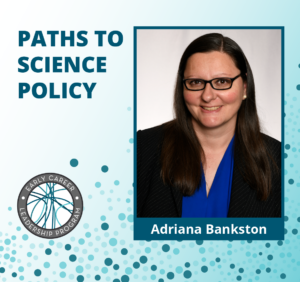
Adriana Bankston: From the Bench to Advocating for Research on Capitol Hill: What Does it Take?
In the Paths to Science Policy series, we talk to individuals who have a passion for science policy and are active in advocacy through their various roles and careers. The series aims to inform and guide early career scientists interested in science policy. This series is brought to you by the GSA Early Career Scientist…